Comment: A reflection on An Garda Síochána and whiny proceduralism
The politics of policing in Ireland has some interesting idiosyncrasies.

By Cian Ó Concubhair
The politics of policing in Ireland has some interesting idiosyncrasies.
For example, it’s odd that the Irish political and media elites who love putting on the green jersey don’t make more of the fact that the form of professional policing practised in much of the world today originated in Ireland. The Irish policing model predated, and directly informed, the English counterpart that emerged in the first half the 19th century. From here the key lessons from the project of Irish policing spread throughout the British Empire.
That Irish policing was a colonial project devised by London to suppress political threats from the recalcitrant Irish might explain the reluctance to acknowledge its influence across the world. It might also explain the myth-making about the foundation of An Garda Síochána and its supposed clean break with the Royal Irish Constabulary.
In the past decade it has become fashionable for politicians and senior gardaí to claim that An Garda Síochána has always policed by consent. This comes from the classic English philosophy of policing. The claim is a fiction. An Garda Síochána was established during a major insurgency, the Civil War, and the force was centrally involved in major counterinsurgency efforts for much of its early decades. Indeed the Special Detective Unit’s predecessor, the Criminal Investigations Department, undertook a terror campaign in the early 1920s, with members murdering a number of very young men. So we are clear: consent models of policing are not reconcilable with counterinsurgency practices, especially terror tactics.
That counterinsurgency tradition has continued throughout the history of the state and has critically informed An Garda Síochána we know today.
An interesting take on neutrality
An Garda Síochána takes a curious approach to politics. At a formal statutory level members of An Garda Síochána are required to be politically neutral. This requirement of neutrality is repeated throughout garda code of ethics and previous Garda commissioners have made much of their obligation to remain politically neutral. These obligations of political impartiality haven’t stopped senior members of An Garda Síochána from lobbying government to pursue particular policy agendas it deems favourable. For example when the Irish Government was considering decriminalising homosexuality in the 1980s senior management lobbied government against it.
This history and these politics converged in a discussion I took part in last week with Paulie Doyle and Harry Browne on The Ditch’s podcast. I was invited because of a piece of research I recently concluded on crime and security journalism in Ireland. Part of that research focused on the relationship between journalists and An Garda Síochána. During the chat we ended up talking about how the force, like other police forces, uses its significant power and status to shape the political environment around it.
I pointed to observations I have made about An Garda Síochána’s conduct during the drug decriminalisation and reform debate in Ireland since the Citizens’ Assembly on Drug Use was established. I have extensive experience in this particular field of policing. I have twice given expert evidence before the Joint Oireachtas Committee on Drug Use.
I am also a convicted drug dealer, which brings its own particular insights and understanding of policing.
I made two observations on the podcast: that An Garda Síochána and Department of Justice have engaged in disinformation campaigns around the use of garda powers to prosecute people for personal possession of drugs; and that garda commissioner Justin Kelly has been campaigning against drug decriminalisation since he featured prominently at the citizens’ assembly.
The citizens’ assembly and oireachtas committee have both recommended decriminalisation of drugs for personal use. This will require repealing section three of the Misuse of Drugs Act 1977. Gardaí, supported by the Department of Justice, have consistently opposed this.
Part of this effort is the claim circulated by both garda sources and the justice minister that people are “rarely if ever” prosecuted for personal possession of drugs. In 2025 around 4,000 people received convictions under section three of the Misuse of Drugs Act. These thousands of convictions aren’t the result of a rare or infrequent prosecutorial strategy in An Garda Síochána.
Why do garda and Department of Justice sources push this lie – and why do major news organisations unquestionably publish it?
It’s a transparent and crude effort to torpedo any move to implement the Citizens’ Assembly or Joint Oireachtas Committee recommendations to decriminalise. These false claims were released immediately after the Oireachtas committee made its final recommendations to decriminalise.
Whatever the motivation, admittedly speculative on my part, there is no question that the claims about the rarity of drug possession prosecutions can properly be described as disinformation.
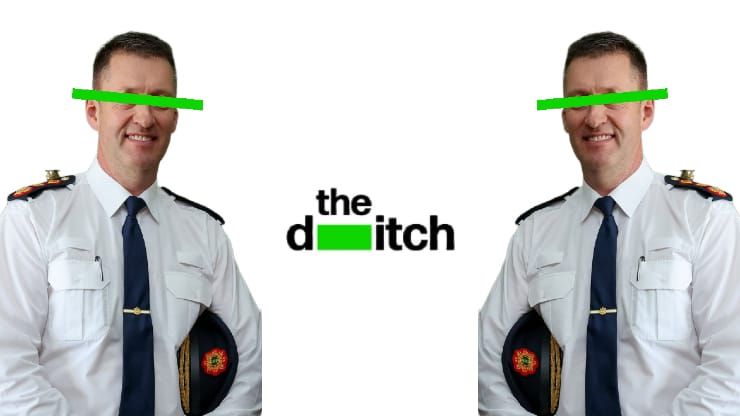
Commissioner Justin Kelly, as an assistant commissioner at the time, featured prominently at the citizens’ assembly and used his platform to warn against decriminalisation.
Drug search powers: some of the most intrusive available to police
That he has publicly opposed decriminalisation – advocating a particular political position – is on the public record. Given the requirement for political neutrality, what is the garda commissioner doing here? With policy changes like this, a profoundly political matter, he could’ve refused to answer, pointing out it is a matter for the Oireachtas (which it is).
Why a police chief like Justin Kelly would oppose decriminalisation is relatively uncomplicated, if cynical, and was described by retired police officer Nick Glynn before the Oireachtas committee in 2024.
In short, drug search powers are some of the most intrusive available to police. These powers give police functionally unreviewable and unchallengeable grounds to stop people and subject them to deep searches of the body and property. Police like the nature of these powers given their enormous scope for use (and misuse). They are typically hostile to any proposed constraint on their powers.
I would add that a lot of senior police careers here and elsewhere have been built on the war on drugs: a policy of spectacular failure in both public health and policing terms.
I don’t particularly care about garda adherence to these specific statutory and ethical standards. An Garda Síochána, like other police forces, is a deeply political organisation. We see it in its different approaches to protest policing – compare, for example, garda responses to farmers occupying government buildings and their response to students – or the definitions of “extremism” they use.
What I do care about is their whiny outraged sensitivity to being called out on their politics. And I wasn’t surprised when the garda director of communications sent this complaint to The Ditch’s editor. “I wish to raise serious concerns with commentary you carried,” he wrote, “that accuses the garda commissioner of engaging in ‘disinformation.’”
At the very least have deliberately misled the public
“As a matter of fact, the commissioner,” continued the email, gives “the expert view of An Garda Síochána based on extensive national and international experience that the de-criminalisation of illegal drugs ultimately benefits organised crime groups, who are engaged in murder, intimidation, slavery and people trafficking.”
I did not claim the commissioner engaged in disinformation. I observed that the commissioner has publicly engaged in a political campaign against decriminalisation – which he has.
Garda and Department of Justice sources have, at the very least, deliberately misled the public about how frequently people are prosecuted for personal drugs possession.
What other word is there for such a campaign, but disinformation?
Maybe they’d prefer to defend the charge by claiming they’re incompetent, that when they made their false claims they hadn’t bothered to check the data, mis- rather than disinformation. That’s a matter for their preference for being called liars, or incompetent.
The outrage from the Phoenix Park, at the term disinformation being applied to garda communications, is partly about state power: when the state lies, it’s not disinformation. It’s just strategy.
But part of the reaction is also about An Garda Síochána’s conception of procedural fairness in public discourse as it pertains to the force.
The demand for a right of reply is familiar to many of us who work on policing and engage in public debate about it. If An Garda Síochána were a force genuinely interested in transparent and thoughtful engagement with research on policing, the call for a right of reply might be justified.
But An Garda Síochána has little interest in that kind of engagement. Requests for comment bring the same non-responses, which don’t engage with the substance of critiques. Such calls for their voice to be heard (when do we not hear the Garda voice?) ring out as deeply disingenuous. As I found in my research journalists in Ireland all understand An Garda Síochána to be deeply hostile to transparency and the accountability it can bring.
Cian Ó Concubhair is Assistant Professor of Criminal Justice in Maynooth University School of Law & Criminology. He researches on policing, criminal law, and news media.