In Godless Ireland we’re abandoned. That Godlessness isn’t about drag queens in zoos and sex education in schools. The God who’s abandoned us doesn’t see the people of Ireland wrestling like Jacob but with matters so trivial. The abandonment isn’t the church’s loss to liberalism and the celebrations we had in Dublin Castle after the two referenda last decade. Our Godlessness is the freedom to choose who we are as a people and how to direct the state that represents us. We’ve been left to make all the choices that cumulatively result in an expression of a collective self. The freedom to make these decisions, to bear what they bring, carries with it the weight of their necessity.
Heavy.
The night before Saint Patrick’s Day, the day we’re to consider what it means to be Irish, Leo Varadkar was tweeting about free speech, one of the ways we establish and express ourselves. Cabinet ministers from half-free Ireland were off shaking hands with the employers of the Irish diaspora. A United States military cargo plane on its way back from Israel would be on the runway at Shannon Airport the next day. The “Ex-Prime Minister (Taoiseach) of Ireland”, as Varadkar’s X bio has it, was replying, in longform thanks to this verified account, to Kneecap.
At 11.14pm he sent the group a 574-character tweet with his thoughts, along with a few typos, about their trip to Cuba onboard the Nuestra América Convoy, bringing medical supplies to the still standing communist state. “Fair play to you for brining supplies”, he wrote, but asked, “might I suggest you call for the restoration of free speech, free assembly and a free press followed by real multi-party elections.” Might I. Yeah I suppose he might.
To Varadkar free speech, rather than the more powerful freedom of expression, is something to invoke in a late-night one-way X spat with a rap group. That he did so with that American influence, against the Cubans who just aren’t free like us, made sense for a man so disturbed by his Cold War anticommunism he once claimed in the Dáil that the Bolsheviks’ 1917 revolution “led to the ending of democracy”. “Under the tsar?” Richard Boyd Barrett had to ask.
In that exchange he also spoke about the banning of free speech and how that’s what countries like Cuba and Venezuela do. Again it was speech he talked about, not expression. Maybe that was deliberate. Because both narrowly and broadly Varadkar spent his political career deciding who gets to express themselves.
The earnest among us were wrong
In 2010 he spoke of his anti-abortion views, telling the Sunday Independent he didn’t have an issue with forcing women to travel to Britain, saying, "You know, are we going to stop people going to Las Vegas? Are we going to stop people going to Amsterdam? There are things that are illegal in Ireland and we don't prevent people from travelling overseas to avail of them." He defended this thinking as late as 2017, before he was able to deduce public sentiment and understand how much work had been done to drag the state to a successful referendum.
As social protection minister he ran his infamous Welfare Cheats Cheat Us All campaign. It was a nominally abortive campaign in that it didn’t recover the sum of fraudulent payments it predicted it would or later claimed. What it did achieve however was instilling a belief, at least temporarily, in the public that social welfare doesn’t alleviate poverty, according to research from ESRI. Varadkar also claimed the campaign led to a more than 50 percent increase in people calling social welfare fraud tout lines, dividing the people who, if united, could form a challenge to his like.
His selective advocacy for freedom of expression defines his political class. Alongside Varadkar for most his career was Micheál Martin. Though the pair didn’t construct the Irish state they’re happy to maintain it in its current form, optimised for the pension funds and foreign institutional landlords making investments in the property market that create wealth for some rather than value for many. This capital, when not extracting every euro it can from the people of Ireland that could otherwise be spent on expression, also creates the conditions for our domestic landlords to apply that same squeeze, the constituency best pleased with the Fianna Fáil-Fine Gael duopoly.
The people subject to their policies and ideology – women seeking healthcare; people unable to work; people looking for the security to truly express themselves – have been free to speak, to say how much they might hate the state having this control over them. But that state doesn’t change on hearing that speech.
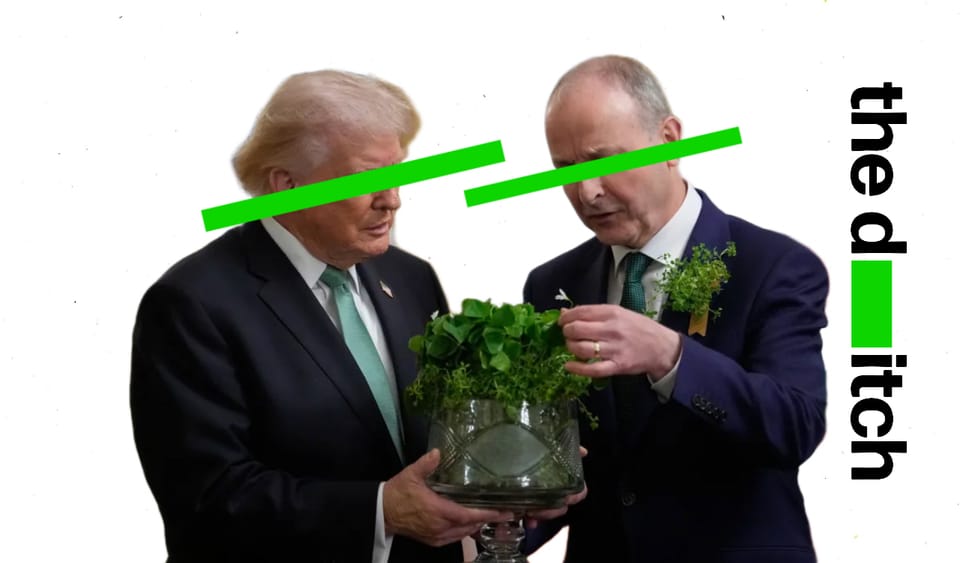
The political project Varadkar and Martin have devoted themselves to, when spoken of plainly, is only popular with a sliver of domestic and foreign elites. Its maintenance requires the type of elisions and surrender to US power Martin was begged to use on his traditional trip to DC for Saint Patrick’s Day.
The earnest among us thought this year could be different, that our customary deference would finally be thought unseemly. The US is an equal partner in Israel’s genocide in Palestine. It has illegally attacked Venezuela and Iran. It’s subjected Cuba to inhumanity. And its nature, its interiority, has never been clearer. The millions of documents partially released as the Epstein files, their publication itself a psychological operation, historicise an evil as pervasive as wifi, enough to make you think the primary conflict of our stupid era is simply good against bad.
Are you for or against the Epstein Empire? When you have a Saint Patrick’s Day engagement in the White House?
Please, Micheál, for us, say nothing
Government and media didn’t want to confront the reality of our relationship with that empire and there was no real question about whether the trip should go ahead. The consensus among Irish media was Martin should say as little as possible. He should turn down the chance to articulate. Inexpression would be a success.
On encountering expression from president Catherine Connolly, an implicit condemnation of the US and Israel’s illegal war, Shane Coleman in the Business Post conceded, “What she said in her statement was quite correct – Donald Trump and Benjamin Netanyahu have driven a coach and four through international law.” After the full stop and decision to start a new sentence for a little drama, he wrote, “But that does not mean she was right to actually say it.” Fionnan Sheahan’s Irish Independent instructions were headlined: “Virtue-signalling populism from Micheál Martin won’t mix with Donald Trump’s unpredictability.” And Pat Leahy in the Irish Times warned against any act of speech from Martin that could ruin “Ireland’s painstakingly built soft power in the US” and “the openness to US businesses and the willingness to bend over backwards to accommodate them”. Please, Micheál, for us, say nothing.
That reflex to shush isn’t an accident. Their pleas to keep quiet rely on the tautology – “it's an ugly word. But so is the thing” – Roland Barthes wrote about in Myth Today. It’s a construction ruling classes use to both describe and build societies in their interests. “Because that's how it is,” wrote Barthes, as if writing a Business Post column himself, is a favourite of these tautologies, which create “a dead, a motionless world”. In the case of Martin’s trip to DC the taoiseach was implored to say nothing, because, well, we never say anything – that’s the way things are. However things are this way because we never say anything. Will that ever change?
The same way the custodians of the country enjoy its current state, the journalists covering the affair over in DC enjoy being there. Gript’s Ben Scallan may lack the guile of, say, an RTÉ Washington correspondent, but when he wrote, “One surreal and cool experience was that you’d regularly see units of American soldiers in full military uniforms going about their business,” he gave a good representation of his press colleagues taking in “the political cauldron like no other”, as Mary Regan described it in the Irish Independent.
From Martin the media and state got what they wanted: nothing – that lack that both describes his vision and is the vision itself.
Those three minutes neatly encapsulated his priorities
Regan marveled at how, “The Fianna Fáil veteran managed to pull off the near impossible feat of avoiding getting into any confrontation with Trump, while also pushing back against the US president’s attacks on the EU and UK.” Keith Duggan in the Irish Times was similarly impressed with Martin’s ability – “for a staggering three unbroken minutes” – to speak, whatever about how he used those minutes. “Strange days indeed”, he wrote, “when the taoiseach is sitting in the Oval Office stepping up to bat for the UK prime minister, Keir Starmer.” But what’s so strange about Martin choosing to use his time to defend a British prime minister and engage in some mild Winston Churchill idolatry (rather than advance Irish interests, as Leahy requested in the same paper?) Those three minutes neatly encapsulated his priorities.
Despite how media rendered the visit it wasn’t made in circumstances so uniquely fraught that silence was Martin’s only choice. Rather, for this class, this studied inarticulacy of all taoisigh helps continue a state project that suits them. Whether it suits the people back home living in Dublin, where opportunity is concentrated in a city built to allow US multinationals express themselves with arcane tax avoidance structures authored by partners in the Irish arms of international consultancies, isn’t a consideration.
Here’s an hypothesis
Where to start to encourage the same freedom of expression for the people of Ireland? Before speech comes thought. “We have to be bold enough to have an idea. A great idea. We have to convince ourselves that there is nothing ridiculous or criminal about having a great idea,” wrote Alain Badiou.
He wrote that in the Communist Hypothesis – an hypothesis I enjoy, maybe not for everyone (for now). Even if you balk at Badiou’s politics at least consider their starting point, so obvious, “that living without an idea is intolerable”, but so rarely arrived at or proceeded from.
“Too many people now think that there is no alternative to living for oneself, for one's own interests. Let us have the courage to cut ourselves off from such people. I am a philosopher, so let me tell you something that has been said again and again since Plato's day. It is very simple. I am telling you as a philosopher that we have to live with an idea, and that what deserves to be called a real politics begins with that conviction,” he wrote.
I found the thoughtlessness and passivity of this Saint Patrick’s Day week objectionable. I made the choice to say something, for whatever that’s worth, and thought of the first line of this piece: In Godless Ireland we’re abandoned. It came to me before I saw what Conor McGregor, who could be expected to consider the idea of Godlessness a certain way, said about Catherine Connolly. In a now deleted X post, the deletion typical of McGregor’s relationship with speech, he called her Godless. It was fodder for the “Irish” Daily Mail, which wrote up his remarks and headlined them: “Conor McGregor brands President Connolly a ‘godless person’ in scathing rant.” Scathing. I wonder whether it was the paper’s social media account managers in Israel who posted the story to Facebook and Instagram.
Just as the God who’s abandoned us doesn’t want us wrestling with drag queens, they’re more likely to ask for sacrifice like that expected of Abraham than your opinion on Connolly’s failure to refer to Patrick as a saint. Becoming the type of state fit for that sacrifice begins with expression.