Comment: The left chooses alternative. The right wants to assimilate
There was a pint of Guinness and a print copy of the Irish Times in front of me in Owen Roe’s in Ballyshannon when a producer from RTÉ’s This Week contacted me to ask if I’d go on the show.

There was a pint of Guinness and a print copy of the Irish Times in front of me in Owen Roe’s in Ballyshannon when a producer from RTÉ’s This Week contacted me to ask if I’d go on the show. This Week. This had been the week that Micheál Martin had taken a cut at The Ditch in the Dáil. I’ll not relitigate. (But will say that even with the protection of parliamentary privilege he didn’t go further than implication.)
I told her I’d go on.
It was three years ago. I’m relying on memory. I’ll try to stick with things I can say for certain but will indulge in a little impression.
I remember leaving the studio in Donnybrook thinking it was more adversarial than I was expecting. I remember presenter Justin McCarthy asking me if I wanted to see a change in government. (Yes.) He asked if we at The Ditch wanted to influence politics. (Yes.) He put it to me that I had criticised people who praise Micheál Martin’s decency. (I had. He cut me off to quote from what I’d written; when he finished I said, yes, that’s what I was saying.) I thought these questions were less an attempted dialogue and more the construction of a case.
RTÉ published a writeup of the interview on its website: “Ditch editor defends work after tánaiste's comments.” I think that’s an accurate summary of what I did in the half-hour interview. I gave a defence of The Ditch, not just “after tánaiste's comments” but to the questions McCarthy chose to ask which cohered with Martin’s comments. Defences are given to attacks.
Journalists consider each other colleagues. All journalists. Not just the ones they share newsrooms with. With as little impression as possible: I don’t think The Ditch participates in that collegiality, not in that interview with Justin McCarthy, who is free of course to hold power to account all he likes, all that stuff journalists tell themselves, just as I am free to wonder if he was right about who held the power that week.
Times (Irish edition) contributor Alison O’Connor caught the interview. “Listening to The Ditch editor @thisweekrte. It’s all as pure as the driven snow apparently,” she tweeted. (I never claimed to have wings on.) “My colleagues in Leinster House do excellent work. Someone coming along & getting a few interesting stories does not undermine that. They’ve nothing to apologise for.” Her colleagues.
Whatever I feel about The Ditch isn’t as important as what others think and the meaning they construct around us. Micheál Martin, as tánaiste, stands up in the Dáil and says things about us he didn’t feel comfortable repeating without parliamentary privilege. Journalists like Justin McCarthy decide we had questions to answer. Alison O’Connor cordons us off from her colleagues in Leinster House.
The affair wasn’t about The Ditch, not even about our reporting on Niall Collins that had angered Martin, but rather legitimacy: who the likes of Martin and RTÉ think should participate. That’s OK.
Recently on The Ditch: The Party Line with Drop Site editor Nausicaa Renner we talked about this, about how at sites like ours you shouldn’t posture as an alternative to the mainstream and then whinge when your opponent acts like you’re not one of them.
Confused politically. (To me at least)
I don’t think I’ve given out about it, how the mainstream reacted to The Ditch during that week of Niall Collins, all that much. I’ve returned to it because of talks I’ve had this last week, other discussions I’ve listened to about right wing politics, their media outlets and commentators.
On the right, somewhere, author Eoin Lenihan is, to me at least, confused politically. Though “I do not waste time or language on our enemies, beloveds,” like Hanif Abdurraqib wrote in There’s Always This Year, I’ll give some time to that confusion, to “tell them that there is a river between what they see and what they know. And they don't have the heart to cross it.”
When he was promoting his book Vandalising Ireland he got the shout to go on the Irish Times podcast. The appearance was to be indulged like it was his Confirmation day. It didn’t go the way he wanted it to.
Around the time of that podcast I took part in a chat about media in Connolly Books. I remember Harry Browne, who’s now hosting The Ditch’s podcast, asking do we, the left, really need to pick a side when the choice is someone like Eoin Lenihan and a paper like the Irish Times. No we don’t, he thought. I agreed with him. The podcast was funny though.
Asked reasonable questions about things he’s said and done, Lenihan was brought to the point of tears, certainly towards emotion, when he decided against answering what he was asked and instead begged of the Irish Times’ Hugh Linehan, have you no humanity?
It betrayed an uncertainty about whether he wants to challenge organisations like the Irish Times or receive their approval. A similar contradiction ran through the fuel protests leaders.
Christopher Duffy couldn’t decide his relationship to the state. One night during the protests he addressed a crowd on O’Connell Street and delighted in telling them they had the country by the balls. A couple days later he was on Facebook, recording a sad front camera video, mourning that Helen McEntee, a lovely girl he used to know, wouldn’t call him.
Though the meaning of these men comes less from what they think and more from how they’re received, these recurring incidents of deference to the state and its institutions at least suggests a question: is this an alternative?
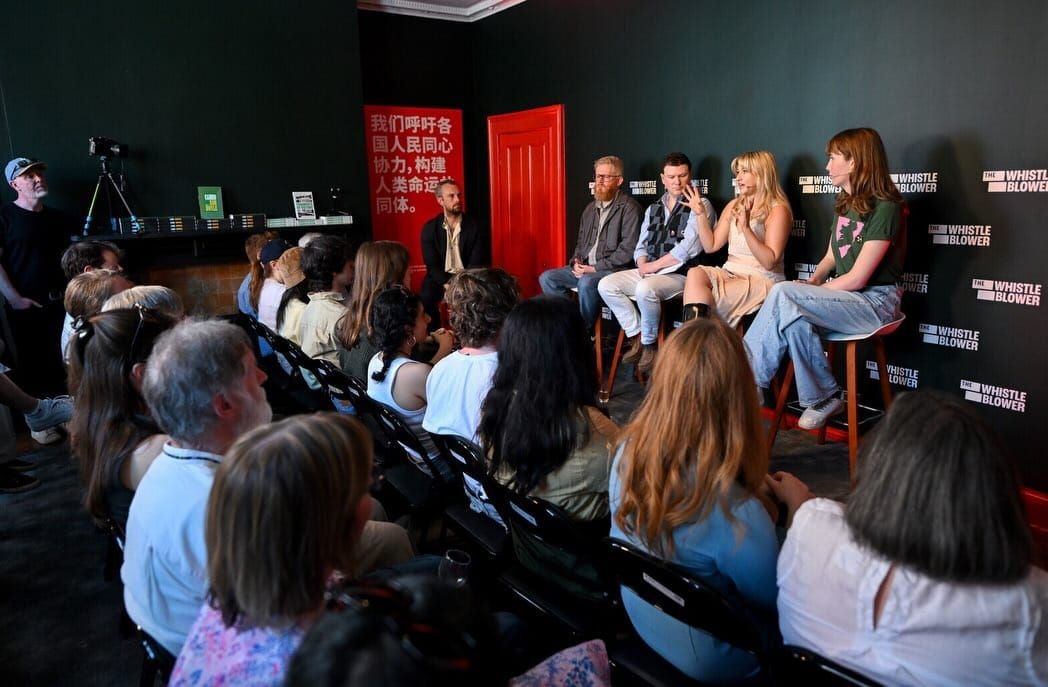
The weekend before last The Ditch helped open The Whistleblower on South Anne Street. Great day, great people, food by Chimac, class. I asked the questions in a panel discussion with Oisín Gilmore, Aoife Grace Moore, Rory Rowan and Jenny Maguire.
Again from memory:
Oisín spoke about interviewing Gerry Adams for An Clogán and why his approach would necessarily differ to a journalist in the mainstream; Aoife talked about how to be critical of Sinn Féin from the left while avoiding right wing anti-republicanism. Rory discussed the reaction to an opinion piece on neutrality he co-wrote for the Irish Times and the attempts to delegitimise rather than argue against the writers; Jenny was happy to say she brings far left politics to the Irish Independent and told us about whom she speaks to, her family in Darndale, when writing her columns.
All of us left wing and all with our own experience of the alternative and mainstream media; all of us speaking about what we’re doing and why we’re doing it.
On that what and why, something Jenny said: it’s good to engage with the mainstream when we can, but, really, the left should be building our own infrastructure, our own thing. She singled out District and Aontacht for their contributions. I agree with the praise and the place it’s coming from.
Building that alternative, both noun and adjective, is hard. And sometimes it remains more aspiration than delivery. But I’ll take an aspiration to a genuine alternative, along with an understanding of what’s to be expected of the state, over the attempts at assimilation from the not-populist-enough-right. This is what we chose.