Go down, Miss Moses, there's nothing you can say / It's just old Luke and Luke's waitin' on the Judgement Day
- Robbie Robertson
The judge interrupted the prosecuting barrister in Ennis Courthouse. He told her he’d heard enough. He was going to adjourn the trial of Áine Ní Threinír, Aindriú de Buitléir and Eimear Walshe. Áine turned to her co-defendants with half a shrug, half a roll of the eyes. Ah, well, fuck it. The Shannon Three would wait again.
Last week a private jet touched down in Shannon Airport. Onboard were Palestinian deportees from the US, their wrists and ankles shackled. The US Immigration and Customs Enforcement – ICE – was sending them to the Israeli-occupied West Bank.
It’s not that the Irish state doesn’t want to involve itself with this depravity – it doesn’t want to acknowledge it. A Department of Transport representative spoke of “technical stops for non-traffic purposes (ie, not picking up or setting down passengers)” with the Irish Times. This private jet, owned by an associate of Donald Trump, which brought Palestinian men in chains to Ireland, does “not require prior authorisation”, they said.
For the last two and a half years the state has done all it can to reserve judgment on Israeli genocide: our territory facilitates it; our parliament blocks the Occupied Territories Bill; our Central Bank enables the sale of Israeli war bonds. What do you do about all that? Something.
The Shannon Three are charged with trespassing at Shannon Airport. They deny the charges. They’ve been on bail for almost two years since their arrest at the airport in March 2024. There are photographs of the action they took that day.
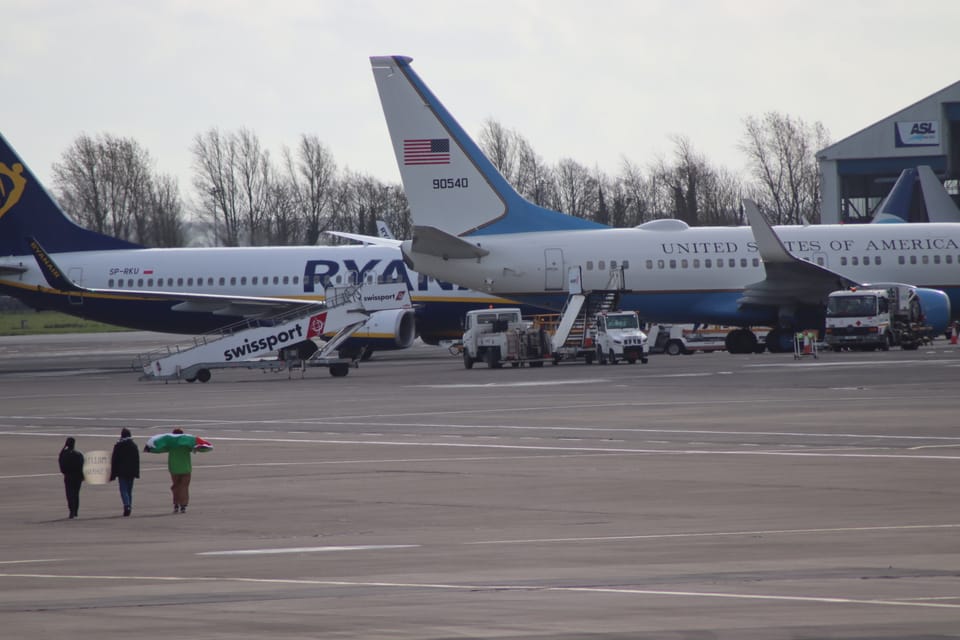
The three appear in the bottom left third of one photo, the expanse of the Shannon runway stretching out to their front and side, a Ryanair and a United States Air Force plane in front of them, facing away, wings upturned like middle fingers. A sign in the right corner indicates the hangar is allocated to ASL Airlines. Three headlines about ASL from The Ditch: Dublin-based firm illegally transported munitions to Israel; Irish airline still delivering munitions of war to Israel; Airline's illegal flight months after call with state. Though dwarfed by the planes the Shannon Three are in motion. The wind lifts the Palestinian flag on Áine’s back, the three are captured mid-step, feet lifted, on their way to address the US military.
That plane they were walking towards was a Boeing C-40B. It’s used for senior military, government leaders and congressional delegations – those considered VIPs – and had left Maryland’s Joint Base Andrews on its way to Cairo, Lebanon, Cyprus and Istanbul before returning to Washington.
Thanks to ShannonWarport, developed by the US Military Out Of Shannon campaign and supported by The Ditch, we also know a United States Navy Boeing C-40 was in Shannon that day. It had left a naval base in Fort Worth, right next to a Lockheed Martin factory, headed for Bahrain International Airport – home of US naval operations in the Middle East.
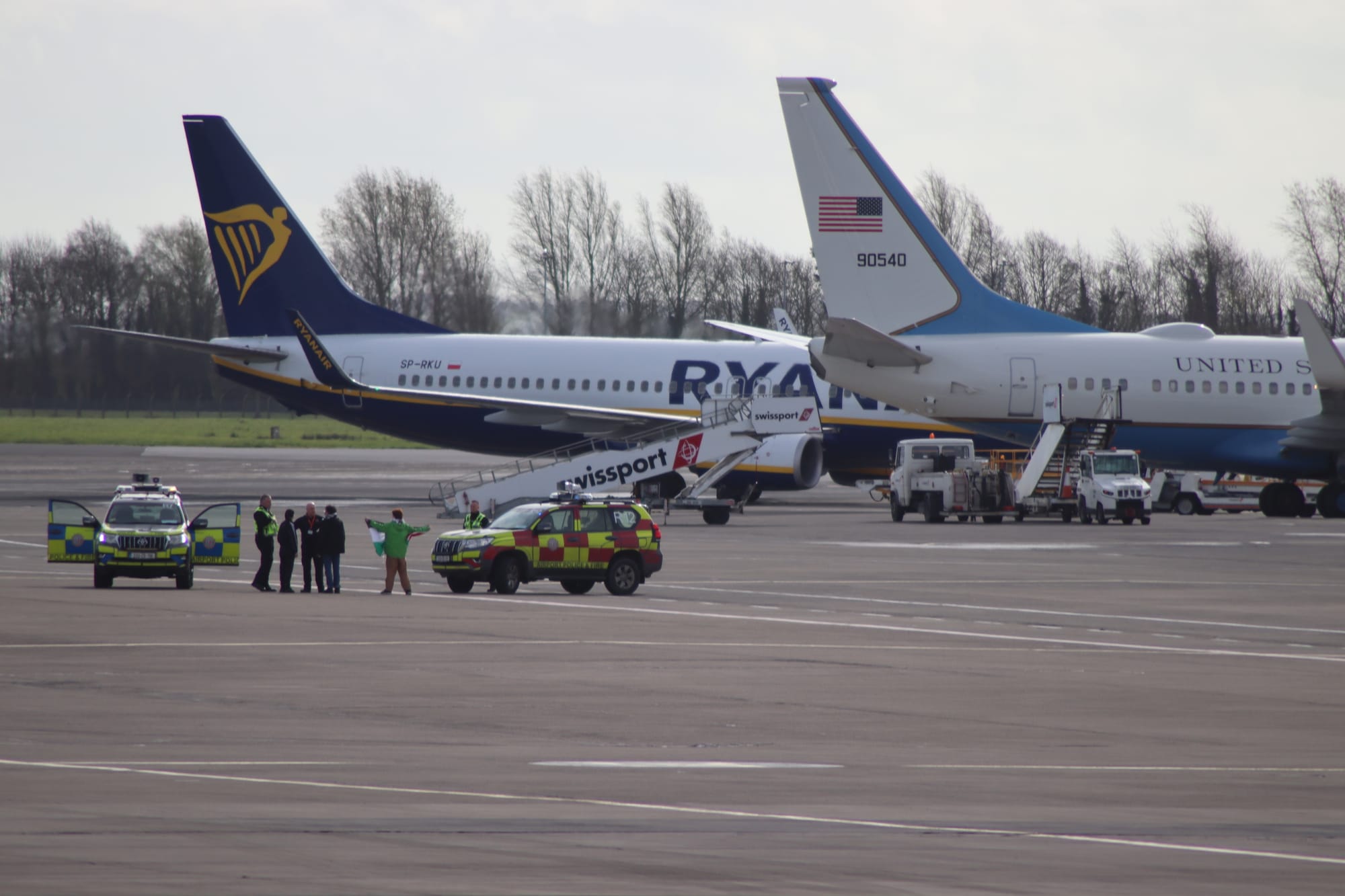
The Shannon Three’s confrontation with this first plane was a decisive act with a clear demand – painted on Aindriú and Eimear’s banner: US MILITARY OUT OF SHANNON – undertaken in the knowledge of the stakes, that prison sentences of two years and fines of €250,000 could follow, that judgment would be delivered. It was an act of faith. No one else was acting.
Søren Kierkegaard in Fear and Trembling, his telling of the story of Abraham and Isaac, wrote, “When an undertaking in which a whole nation is concerned is hindered, when such an enterprise is brought to a standstill by the disfavour of heaven, when the angry deity sends a calm which mocks all efforts, when the seer performs his heavy task.” For Kierkegaard, Abraham’s resolution to kill his son had him suspend conventional ethics for trust in a higher cause. Called to act Abraham “will magnanimously conceal his pain, even though he might wish that he were ‘the lowly man who dares to weep,’ not the king who must act royally”. And he was ready to face the consequences of his decision.
If it wasn’t transcendence that defined the action maybe it was Quixotism. Even Che Guevara, writing to his parents in 1965 after leaving Cuba for Africa and Latin America, spoke of how, “Once again I feel beneath my heels the ribs of Rocinante,” referring to Don Quixote’s horse. “Once more, I’m on the road with my shield on my arm.” And he too understood the enormity of the forces opposing him and the almost unreality of his facing up to them, “Now a willpower that I have polished with an artist’s delight will sustain some shaky legs and some weary lungs. I will do it. Give a thought once in a while to this little soldier of fortune of the twentieth century,” he wrote.
'The weekly vigil at Shannon will continue'
The chatter round the courthouse was the case would be deferred again. Last week another anti-war activist, Daniel Dowling, got leave to appeal trespass charges over an action at Shannon to the Supreme Court. That appeal will concern the defence of necessity – the argument that the defendant had no lawful alternative to their actions. The Shannon Three say they were trying to inspect a US military plane, something the Irish state refuses to do. It seems their defence will also involve necessity.
Right enough, inside the courtroom, the Shannon Three in their seats, the state’s prosecuting barrister Sarah Comerford rose and referred first to this Supreme Court appeal. The facts of the case are similar, she said, and that having reviewed defence documents she anticipated a similar defence. Now came a performance of magnanimity. The defence hadn’t been well ventilated in this jurisdiction, she said. Though she didn’t know if the Shannon Three intended to rely on it, were they to apply for an adjournment, the state would of course, generously, consent.
Defence counsel Patrick Whyms responded. We’re aware, he said, of the case and the similarities. “It is undoubtedly the case it’s a relevant defence,” he said. With a little theatre himself, no harm, "Nevertheless," he said, with a pause, “The three accused are happy to proceed.” This threw the state a little, with Comerford changing her position from the state being willing to consent to an adjournment – that performance – to the state requesting one.
This was where judge Francis Comerford interjected. He wasn’t happy asking a jury to adjudicate on a matter of law that he thought lacked clarity. What does this all mean. (And could a jury not be trusted to understand what's at stake?) Already 22 months in purgatory, Áine Ní Threinír, Aindriú de Buitléir and Eimear Walshe will now wait for that conclusion of that Supreme Court case.
The continuity from Irish anti-war efforts during the so-called war on terror to the Shannon Three is obvious and implicit in their actions. It crosses to explicit when other activists like Sinéad Ní Fhaoláin, who appeared in the same courthouse last May for a separate action, says, “We're building on a legacy of over 23 years of resistance to US use of Shannon Airport, which is a direct breach of our neutrality, which the majority of the country is for. We're building on that resistance.”
Or when supporters out on the courthouse steps say they’re reading and taking inspiration from Harry Browne’s writing on the Pitstop Ploughshares, activists from the Catholic Worker Movement who beat criminal damage charges for their action at Shannon Airport back in 2003. “Taking personal responsibility for actions is one of the cornerstones of the ‘ploughshares’ tradition. In the words of Dan Berrigan: ‘Don’t just do something, stand there,’” as Harry wrote in the Dublin Review.
Ed Horgan, there in Ennis Courthouse yesterday, there all the time, said, “The adjournment underscores the profound legal and moral questions at the heart of these prosecutions. For over two decades, the state has persistently criminalised citizens who act out of necessity to confront Ireland’s complicity in war and genocide, while refusing to inspect or halt the US military flights themselves.”
Outside the courthouse, with a congregation gathered on the steps, spokespeople gave updates. “It’s disappointing it’s not going ahead but it’s for a really good reason,” said one, speaking with the same hope Ed has for the Supreme Court appeal. The movement persists. “Even though the trial isn’t going ahead, all the other activities are. The weekly vigil at Shannon will continue.”