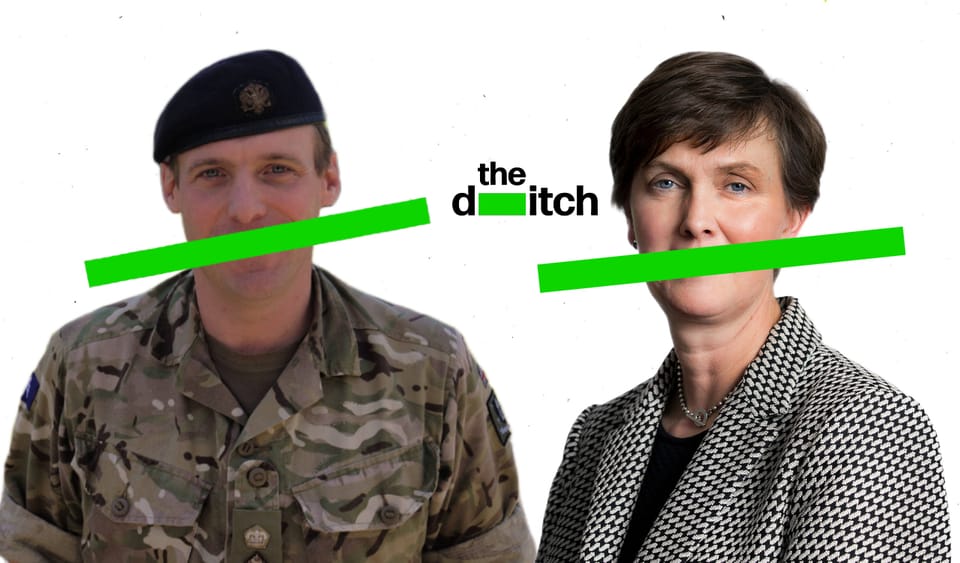
The Department of Defence recruited a British Army colonel – who served in the occupation of the north of Ireland and invasions of Iraq and Afghanistan – to advise a state body tasked with reforming the Irish Defence Forces.
Department of Defence secretary general Jacqui McCrum requested that colonel Simon Farebrother join the Defence Forces’ external oversight body – with an internal memo noting the British secretary of state who would make the final decision.
Farebrother’s British Army troop took part in the Battle of Basra during the invasion of Iraq – which killed more than 1 million Iraqis – and will now advise the Irish Defence Forces on reforming its culture, behaviour and accountability.
‘Ultimately, it will be the UK secretary of state who will make a decision’
The Defence Forces’ external oversight board was established after a 2023 report by the Independent Review Group (IRG) which found a “toxic” culture in the forces.
The report documented widespread bullying, harassment, sexual harassment and sexual misconduct.
The external oversight body formally came into operation in December 2024.
Serving British Army colonel Simon Farebrother is a “subject matter expert” to the board, alongside Department of Defence secretary general Jacqui McCrum, former policing board head Josephine Feehily and former Enterprise Ireland CEO Julie Sinnamon.
McCrum discussed the appointment during a January 2025 meeting with the British Ministry of Defence, according to records released under freedom of information. He joined the board that June.
A confidential note of that meeting says there was a “short discussion about the Irish request for colonel Farebrother to join the external oversight body as a subject matter military expert”.
“A memo will be going to PS Williams shortly regarding it,” the note adds. “Ultimately, it will be the UK Secretary of State who will make a decision on this request.”
Farebrother was commissioned into the Queen’s Dragoon Guards in 2001, a British regiment specialising in reconnaissance. His deployments include Operation Banner in the north, Operation Telic in Iraq and Operation Herrick in Afghanistan.
According to his official biography posted online by the Department of Defence, Farebrother has “played a key role in supporting the British Army’s response to public inquiries and coronial inquests”, with a focus on “organisational accountability, professional standards, and duty of care”.
In a British Army podcast, Farebrother described the military culture he joined in the early 2000s as “misogynistic, homophobic (and) racist in terms of its language”, saying he “assimilated” into behaviours he believed were expected of him at the time, though he now rejects them.
A Department of Defence spokesperson told Farebrother is not a member of the body but has been engaged, with ministerial consent, as a subject-matter expert to assist its work.
“Colonel Farebrother is engaged as a subject matter expert, not appointed as a member,” the spokesperson said. “He has particular expertise in cultural change, oversight in complex environments, and the development of ethical leadership.”